
I started with disposable cameras on summer holidays in Valtellina. My mother had a camera she liked to play with, and watching her use it was the first time I understood that a photograph was something a person made rather than something that simply happened.
I never trained. Everything I know about light I learned by standing in it — waiting, mostly, and fairly often freezing.
The moment it stopped being private
Years later I was in Iceland, photographing on a black-sand beach, when a couple walking past stopped to look at what I’d shot and asked if they could buy a print. A few months after that, the same thing happened in Morocco.
Until then, photography had been my way of disconnecting, of paying attention to something other than work. Those two conversations changed what it was. If a stranger wanted to live with one of these images, then what I was doing for myself was also something I was doing for other people.
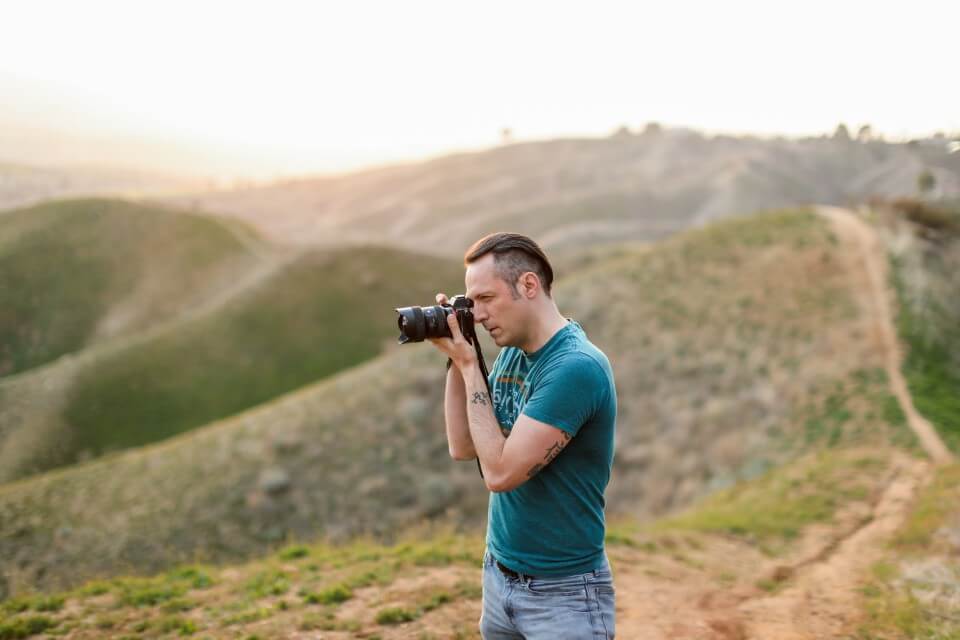
I try to fix an emotion into a digital file,and hope it reaches you. Maybe the one I felt standing there, maybe one entirely your own.
What I’m actually after
A literal record of a mountain is a document. I’m after the other thing: the version your memory keeps, which is always louder and stranger than the original. Whether I’m photographing glaciers, northern lights or a bison in a burnt forest, the question is the same one: how does this make somebody feel?
Which is a strange thing to attempt, when you think about it. An emotion is the least transferable thing there is, and I’m trying to fix one onto a sensor, then a screen, then a sheet of paper or aluminum on somebody else’s wall. Most of the work — the waiting, the color, the choosing — is about getting the feeling through all of that intact.
That’s where Hypercolor came from. It isn’t a filter; it’s a way of pushing a scene past what the eye records until it matches what being there actually felt like. Some of my work sits at the far end of that, closer to abstraction than to landscape. Some of it is straight monochrome. Both come from the same instinct.
Where the work has taken me
Fifty US states. More than thirty countries. Glacier caves in Alaska, the Gokyo Lakes and Cho La Pass in Nepal, the Faroe Islands, Patagonia, the Dolomites I grew up beneath. I trekked to Kala Patthar rather than Everest Base Camp, because Base Camp gives you a milestone and Kala Patthar gives you Everest: gold, unobstructed, in complete silence. That was the moment I went for.
Alongside the photography, I spent my career as a marketing leader in advertising. It taught me to treat this as a craft and a business; to build opportunities rather than wait for them, and to learn how to talk about work that, as an introvert, I would rather just quietly make.
Prints
Hundreds of people have chosen to live with one of my photographs. Open editions are printed and delivered worldwide on paper, canvas, metal, or acrylic. Collector pieces are signed, numbered, and made to order in Fujiflex face-mount or brushed aluminum, sized for a specific wall and light.
I like this part more than I expected to. Walking someone through why one material suits their room and another doesn’t is, oddly, the closest photography gets to being a conversation.
Photography is my safe place. Through each print, I want to share not just an image but the feeling of standing there.


